



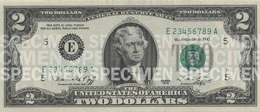
The federal government issued the first $2 notes (called United States Notes or "Legal Tenders Notes") in 1862 and featured a portrait of the first Secretary of the Treasury, Alexander Hamilton (1789-1795).
The first use of Thomas Jefferson's portrait on $2 notes was on Series 1869 United States Notes. The BEP has used the same portrait for all series of $2 United States Notes as well as for all $2 Federal Reserve notes.
The series 1928 $2 United States Note was the first to feature Monticello, Thomas Jefferson's estate in Virginia, on the back.
In celebration of the United States' bicentennial, the Bureau introduced a $2 Federal Reserve Note, Series 1976. The new design maintained the portrait of Jefferson on the face, but the back was changed from Monticello to a vignette of the signing of the Declaration of Independence. The most recent printing of the $2 note has the Series 2017A designation. There are no plans to redesign the $2 note.
The vignette on the back of the current $2 Federal Reserve note features an engraving of John Trumbull's painting "Declaration of Independence." The original Trumbull painting portrayed 47 people, 42 of whom were signers of the Declaration (there were 56 total). However, because of a limited amount of space on the note, five of 47 men in the painting were not included in the engraving.
$2 Note Fact Sheet (PDF)
All U.S. currency remains legal tender, regardless of when it was issued.